Quick Enquiry
Thank you for your query!
Your inquiry has been received. We appreciate your interest.
Our team will review your message and get back to you as soon as possible.

Thank you for your query!
Your inquiry has been received. We appreciate your interest.
Our team will review your message and get back to you as soon as possible.




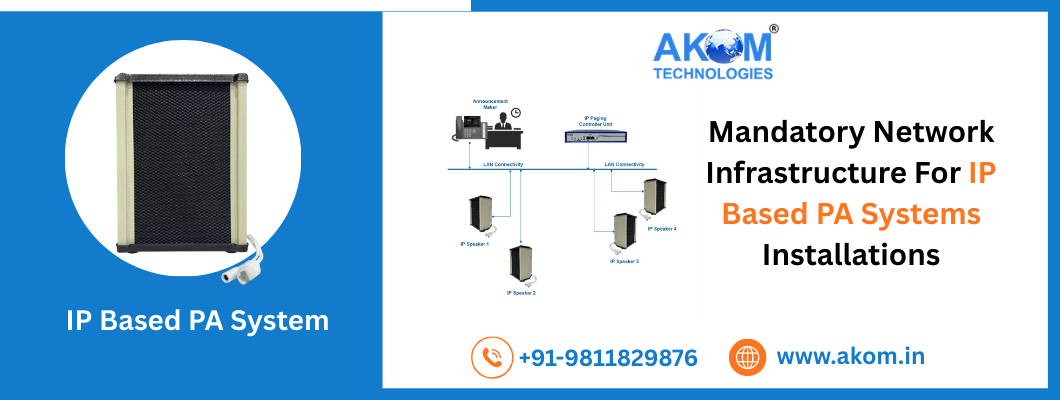
Communication plays a really key role in holding productivity, safety and operational efficiency in workplaces itself. Whether it's a busy office atmosphere or a big industrial facility, teams will need very dependable systems that make rapid communication and coordination possible themselves. Traditional intercom systems have actually been serving business for many years but modern workplaces need much more adaptable and scalable solutions themselves. This is where an IP audio intercom is practically an essential communication tool.
Through using internet protocol technology, an IP audio intercom offers better connectivity, a superior audio quality and also seamless integration with existing communication systems themselves. Offices and factories are increasingly adopting these systems themselves to streamline their operations and also further enhance workplace communication itself.
One of the largest benefits of an IP audio intercom is much faster and more efficient communication. Within workplaces where immediate information sharing is essential, delays could seriously impact productivity and your workflow.
An IP-based intercom allows employees to really talk with one another instantly across departments, floors or buildings - without having to physically move or use several communication systems. This is particularly valuable in factories where production teams, supervisors and warehouse personnel have to coordinate in real time.
In office environments this will enable rapid announcements and direct conversation between departments - thus greatly reducing response times and making your whole operation much more efficient.
Traditional analogue intercom systems will often see signal degradation and background noise themselves, particularly in very large facilities. An IP audio intercom offers superior voice clarity since your communication happens over digital networks itself.
Clearer audio quality makes sure that messages are very easily understood - something that is crucially important in those very noisy industrial environments themselves. Better sound quality will reduce those misunderstandings and thus help keep your operation flowing much more smoothly itself.
High-definition audio further enhances the communication in emergency or highly urgent situations themselves where every single message has got to be communicated perfectly accurately.
Modern businesses mostly use several communication platforms - including IP PBX systems, VoIP phones and security systems. One major benefit of an IP audio intercom is the ability to integrate very smoothly with such existing technologies.
Integration will allow businesses to set up a unified communication setting whereby intercom calls can connect with desk phones, mobile applications and VoIP platforms. This really simplifies communication management and cuts down on the requirement for separate systems.
For organisations looking to modernise themselves step by step, integration capabilities make installation a lot simpler and a lot more cost-effective.
Security is a top priority in factories, warehouses, manufacturing plants and quite large office campuses. An IP audio intercom will really strengthen workplace safety by making possible immediate communication during emergencies.
Security teams are able to rapidly make public announcements across entire facilities, inform staff about potential hazards or determine evacuation procedures themselves. In factories supervisors are able to instantly pass on safety instructions to workers over the entire production area itself.
If combined with surveillance systems and access control solutions, then the intercom system itself forms a key part of your complete security set-up.
Business growth is very likely to generate new communication challenges. Traditional systems actually demand a wide range of hardware updates and rewiring to really expand them. An IP audio intercom provides greater scalability because it functions by means of your existing network infrastructure.
New devices and communication points can be quite easily included. If you are expanding on to new office floors, different parts of a factory or even into additional buildings, your business will be able to scale its communication systems with hardly any necessary investments in your infrastructure itself.
This flexibility makes IP-based intercom systems a long-term communication solution.
Setting up traditional communication systems requires quite costly wiring and very important infrastructure modifications. An IP audio intercom works with your existing network cable, making installation a lot less complex and thereby lowering the cost of deployment.
Maintenance itself will be a lot easier since software-based systems are managed remotely in many cases. Updates, monitoring and even troubleshooting can all be done from one place - thus minimizing downtime and reducing the cost of maintenance itself.
Lower operating costs make IP intercom systems an attractive investment to both small companies and very large corporations.
Modern workplaces rely more and more on remote operations and distributed teams themselves. An IP audio intercom will support your remote communication by letting you access and manage the system itself via networked devices.
Facilities managers, administrators and security personnel will be able to monitor all communication activity and control the system's settings from anywhere. This added flexibility improves your responsiveness and lets communication keep flowing - even if you're not right there in the building itself.
The ability to remotely manage is particularly handy for businesses that work out of multiple locations.
Communication delays will sometimes create workflow bottlenecks. When an IP audio intercom enables real-time communication between departments and teams, it improves coordination and really tightens up your operation's efficiency.
Manufacturing supervisors will be able to immediately communicate production updates whilst office teams will be able to work together a lot more effectively - all without interruptions. Communication at a faster pace really supports better decision-making itself and helps keep operations really smooth right across the various departments.
Better coordination contributes pretty directly to your productivity and gives you a much better performing workplace.
Installing an IP audio intercom will give your office or factory a range of advantages - better communication efficiency, enhanced security, scalability itself and a lot lower running costs. By making the most of your current network infrastructure and making it possible to integrate it with the latest communication systems, these solutions really do help your business make a more linked and productive working environment. As organisations carry on adopting digital technologies, IP based intercom systems offer a very stable base for a communications system that is truly ready for the future.
At Akom Technologies, we offer high-end communication solutions - including super-reliable IP audio intercom systems created for offices, factories and those demanding industrial environments. We focus on giving you scalable, efficient and tightly integrated communication technologies which will really improve the links within your workplace. Partner with us to really make a difference to your collaboration and build a much smarter communication system.
1. What is an IP audio intercom?
An IP audio intercom is a network-based communication system that transmits voice communication via internet protocol infrastructure.
2. Can IP audio intercoms be used in factories?
Yes, they are commonly found in factories for communications, announcements and for coordinating safety.
3. Are IP audio intercom systems scalable?
Yes, new devices may be easily integrated into the system using the existing network infrastructure.
4. Will IP audio intercoms integrate with VoIP systems?
Yes, they integrate very smoothly with IP PBX systems, VoIP platforms and all the usual communication tools.
5. Is the installation itself expensive?
No, since they make use of your existing network infrastructure, the installation costs themselves are generally lower than those for traditional systems.
Subscribe to our newsletter for a weekly dose of news, updates, helpful tips, and exclusive device.
 sales@akom.in
 +91-9811829876