Quick Enquiry
Thank you for your query!
Your inquiry has been received. We appreciate your interest.
Our team will review your message and get back to you as soon as possible.

Thank you for your query!
Your inquiry has been received. We appreciate your interest.
Our team will review your message and get back to you as soon as possible.




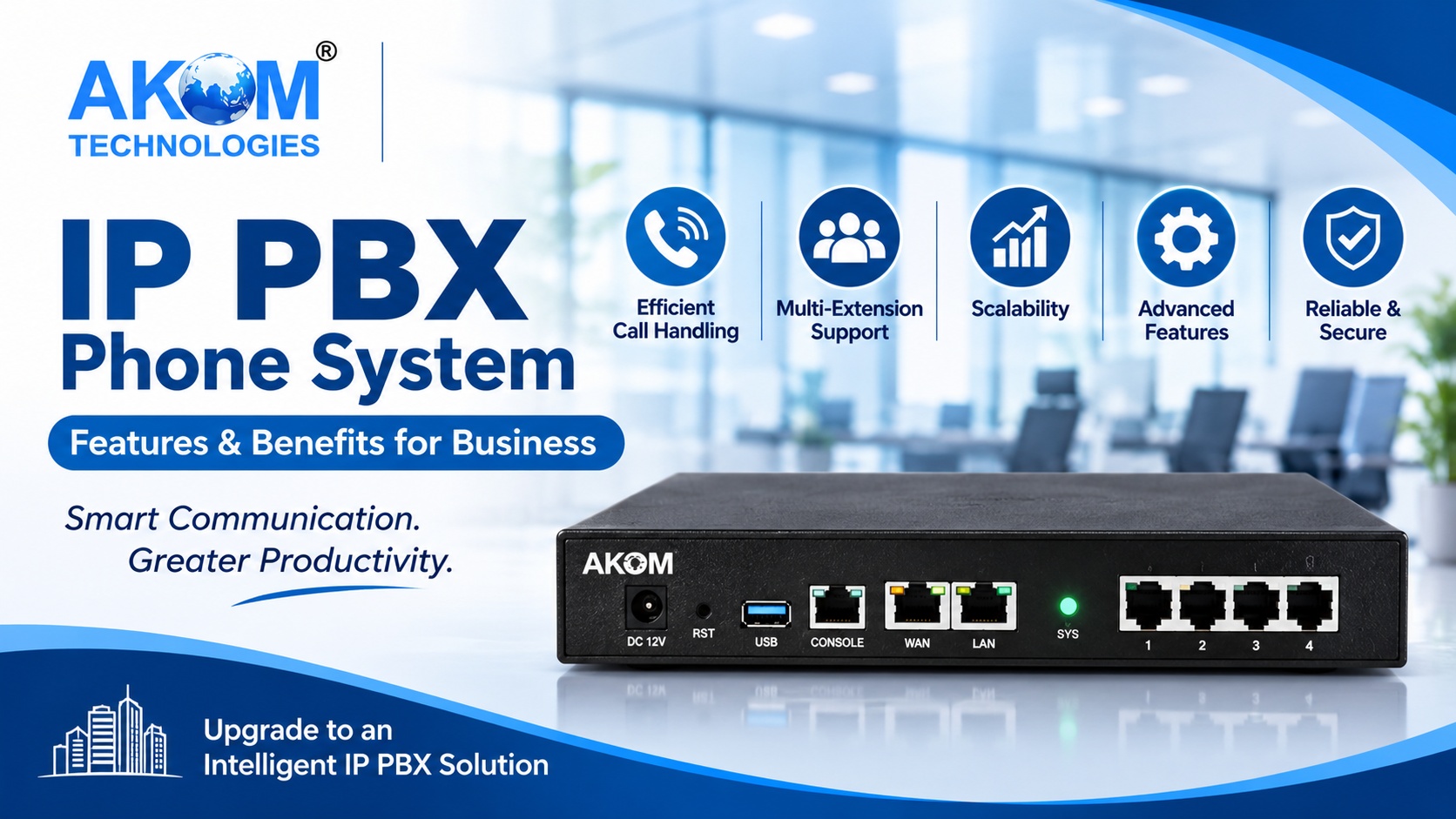
Businesses increasingly use digital communication to connect employees, serve customers and manage daily operations. Traditional phones may handle basic calls, but growing organizations often need flexible communication across departments and locations. An IP PBX phone system helps manage these needs over an internet protocol (IP) network.
For businesses in India planning a telephone system upgrade, understanding IP PBX features can help them choose a suitable solution.
IP PBX stands for Internet Protocol Private Branch Exchange. It is a business telephone system that uses Voice over Internet Protocol (VoIP) to manage calls over an IP network. Voice is converted into digital data rather than relying only on traditional telephone lines.
The IP PBX manages employee extensions and incoming call routing. A typical setup includes an IP PBX server, IP phones or softphones, a SIP trunk to connect with a telecom provider, network infrastructure and, when needed, a VoIP gateway for compatible analog equipment. It can be installed on-site, hosted or deployed in a hybrid configuration.
An IP PBX uses VoIP to carry calls over an IP network. SIP (Session Initiation Protocol) commonly establishes and manages calls, while RTP (Real-time Transport Protocol) carries voice data.
The process starts when an IP phone registers with the PBX. An employee then dials an extension or external number. The PBX checks permissions, routes the call to the correct person or queue, and sends voice as digital packets. Users can manage calls through features such as transfer, hold, conferencing and voicemail. This centralized approach avoids the need for a separate exchange for every employee.
Key features include IVR menus that direct callers to departments; call forwarding and transfer to reach the right colleague; conferencing for group discussions; call recording, subject to applicable law and consent, for service reviews; voicemail and call queues for busy or unavailable teams; centralized extension management; and remote access through compatible IP phones or softphones.
Growing companies may need more extensions, simultaneous calls, departments or connected offices. An IP PBX can support expansion by adding users, increasing SIP trunk capacity, linking branches and managing call policies centrally.
Capacity depends on the PBX model, licensing, server resources, network bandwidth and telecom configuration. Businesses should assess future requirements before deployment.
IP PBX solutions can connect office departments, help call centers manage enquiries, coordinate healthcare reception and appointments, link school administration teams, support hotel and retail bookings, and connect employees across multiple business locations.
Check the number of users, expected simultaneous calls, SIP compatibility, network quality, security, integrations and technical support. Confirm that the system can expand as your business adds employees or locations. Planning these requirements can help reduce communication interruptions during installation.
An IP PBX phone system provides centralized call handling, employee extensions and communication between departments or locations. AKOM Technologies offers networking and communication solutions for businesses in India. Before installing or upgrading a telephone system, identify the required extensions, call capacity, network infrastructure and essential features. Explore AKOM Technologies' IP PBX solutions to learn more about business communication options.
1. What is an IP PBX?
A business phone system that manages calls and extensions over an IP network.
2. How is IP PBX different from VoIP?
VoIP carries voice over IP networks; an IP PBX manages extensions and call routing.
3. Is IP PBX suitable for small businesses?
Yes, when capacity and features match business needs.
4. Can it connect multiple offices?
Yes, with compatible equipment, network connectivity and SIP services.
5. Can analog phones be used?
Often, through analog ports or a compatible FXS gateway.
6. What should I check before installation?
Check capacity, SIP compatibility, network quality, security, scalability and support.
Subscribe to our newsletter for a weekly dose of news, updates, helpful tips, and exclusive device.
 sales@akom.in
 +91-9811829876