Quick Enquiry
Thank you for your query!
Your inquiry has been received. We appreciate your interest.
Our team will review your message and get back to you as soon as possible.

Thank you for your query!
Your inquiry has been received. We appreciate your interest.
Our team will review your message and get back to you as soon as possible.




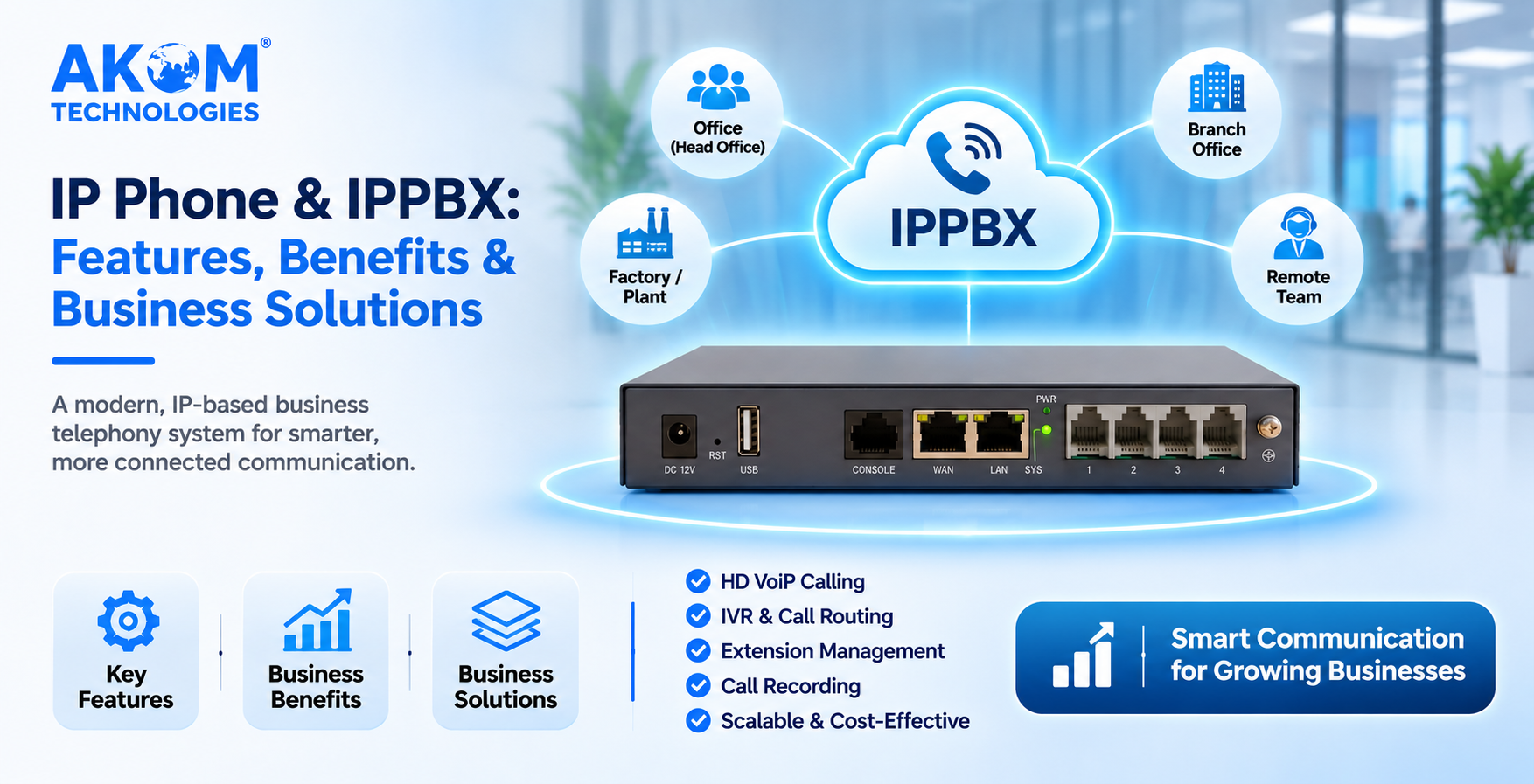
Effective communication is essential for every successful business. Whether you operate a startup, a small office, or a busy customer support centre, a reliable telephone system helps maintain clear communication between customers, employees, and business partners.
However, traditional telephone systems can limit scalability, increase maintenance requirements, and lack advanced communication features. This is why many modern businesses are adopting IP-based communication systems.
An IP Phone & IPPBX solution simplifies business communication by combining Private Branch Exchange (PBX) technology with Internet Protocol (IP) telephony. It allows organizations to manage internal extensions, incoming and outgoing calls, call forwarding, and conference calls through an internet-based network.
This technology helps Indian businesses improve communication efficiency, manage calls effectively, and control operational costs.
An IP PBX is a business telephone system that manages incoming and outgoing calls over an Internet Protocol (IP)-based network. It uses Voice over Internet Protocol (VoIP) technology to transmit voice calls through an internet or private network instead of relying entirely on traditional telephone lines.
A PBX system connects multiple employees through shared telephone lines and internal extensions. Employees can communicate with one another using extension numbers, while incoming customer calls are directed through a centralized communication system.
Modern systems support IP phones, softphones, SIP devices, and even traditional telephone sets when compatible gateways or interfaces are used.
An IP PBX phone system is particularly beneficial for companies looking to centralize communication across departments, branch offices, and customer support teams.
An IP PBX phone system operates through network connectivity, Session Initiation Protocol (SIP) signalling, and VoIP technology.
It manages the setup, control, and termination of voice calls between connected users.
Typically, the process works as follows:
This centralized process helps businesses manage multiple conversations and maintain efficient communication.
Modern business telephone systems offer several features that improve communication, customer service, and employee productivity.
Businesses can use Interactive Voice Response (IVR) to create automated greetings and menu options. Customers can select departments such as sales, customer support, accounts, or technical assistance without requiring an employee to manually redirect every call.
Employees can forward incoming calls to another department, extension, or mobile number. Call transfers help customers reach the right person quickly and reduce unnecessary delays.
Conference calling allows multiple participants to communicate through a single telephone call. This feature is useful for internal meetings, client discussions, remote collaboration, and business coordination.
Ring groups distribute incoming calls among multiple employees, while call queues allow customers to wait until an employee becomes available.
These features help businesses manage high call volumes and reduce the chances of missed customer enquiries.
Call recording allows businesses to review conversations, monitor service quality, train employees, and improve customer support.
Call Detail Records (CDRs) provide information such as call duration, date, time, telephone extensions, and calling numbers.
Voicemail allows customers and employees to leave messages when the intended recipient is unavailable.
Remote connectivity also enables authorized employees to access business telephone extensions from different locations, depending on the system's configuration and capabilities.
Implementing an IP PBX solution can provide several advantages to organizations looking to improve their communication infrastructure.
Using internet-based voice communication instead of traditional telephone lines can help businesses reduce calling expenses, particularly for communication between different offices and locations.
Features such as speed dial, call forwarding, IVR, and ring groups simplify everyday communication tasks. Employees can manage calls more efficiently and spend more time on their core responsibilities.
A scalable telephone system allows businesses to add new extensions and devices as their workforce grows, subject to the system's user and licensing capacity.
Features such as automated attendants, call queues, and call distribution help customers connect with the appropriate departments. This improves call handling and creates a smoother customer experience.
Businesses operating from multiple locations can connect their communication systems, allowing employees to communicate using internal extensions.
IT administrators can manage extensions, call routing rules, communication settings, and other system configurations through a centralized management interface.
Selecting the right communication infrastructure is important for businesses. Organizations should evaluate their current requirements as well as their future communication needs.
Before purchasing an IP PBX system, consider the following factors:
Understanding these requirements will help businesses choose a communication solution that supports their operations without requiring frequent infrastructure changes.
AKOM Technologies offers business communication and networking solutions designed to meet the requirements of different organizations.
Its IP PBX product range includes solutions for small, medium-sized, and large businesses, as well as enterprise communication environments.
Depending on the model, available features include:
For example, the IAX 100 IP PBX is designed for small and medium-sized businesses and supports up to 100 SIP users. The UC1000, on the other hand, offers an enterprise-level platform with support for hundreds of extensions and advanced call management capabilities.
AKOM Technologies provides different networking and communication products to help organizations select equipment according to their extension requirements, simultaneous call capacity, and operational needs.
Explore AKOM Technologies' IP PBX Solutions:
An IP PBX phone system is a business telephone solution that uses Internet Protocol technology to manage internal extensions and external calls. It supports features such as call routing, voicemail, conference calling, and automated call management.
VoIP is the technology used to transmit voice communications over IP networks, whereas an IP PBX is a telephone management system that uses VoIP technology to control and route business calls.
Yes. Businesses can connect multiple offices using compatible SIP trunks, VPN connections, and other supported networking technologies. This allows employees at different locations to communicate using internal extensions.
Yes. There are IP PBX solutions designed specifically for startups and small businesses. They provide essential calling features, extension management, and scalability to support business growth.
Yes. Traditional analog phones can be connected to an IP-based communication network using compatible FXS ports or an external FXS gateway.
Important features include extension management, simultaneous call handling, IVR, call forwarding, call recording, conference calling, SIP compatibility, security, remote connectivity, and centralized administration.
Business communication is no longer limited to basic telephone connectivity. Modern organizations require flexible, scalable, and feature-rich communication systems that support employees, customers, and business operations.
An IP PBX phone system provides centralized call management through VoIP technology, helping businesses streamline communication, improve call handling, and manage everyday conversations more efficiently.
By evaluating extension capacity, network compatibility, security, and calling features, organizations can select a solution that meets their long-term requirements.
AKOM Technologies offers a range of communication and networking solutions for businesses in India looking to modernize their telephone infrastructure and build a more efficient communication environment.
Subscribe to our newsletter for a weekly dose of news, updates, helpful tips, and exclusive device.
 sales@akom.in
 +91-9811829876