Quick Enquiry
Thank you for your query!
Your inquiry has been received. We appreciate your interest.
Our team will review your message and get back to you as soon as possible.

Thank you for your query!
Your inquiry has been received. We appreciate your interest.
Our team will review your message and get back to you as soon as possible.




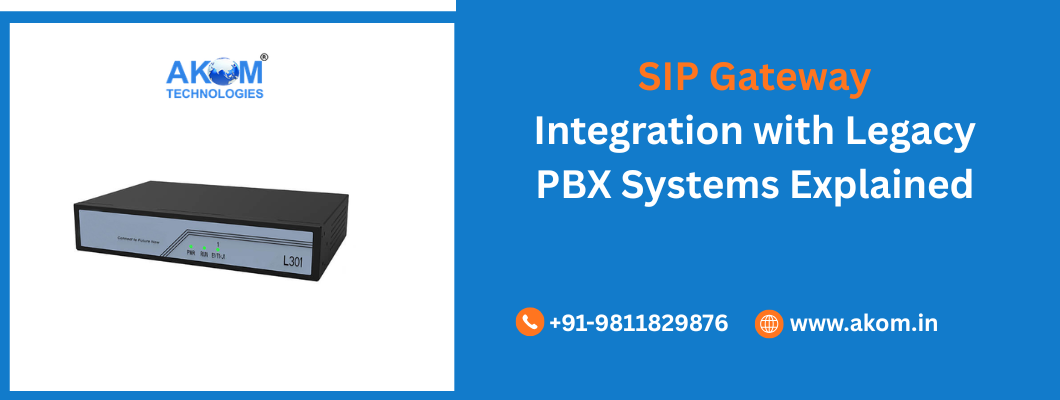
Business communication needs are subject to change as businesses change. Although the modern VoIP systems are increasingly becoming popular, there are still several organizations who are using the older PBX systems in their day-to-day operations. Complete replacement of these systems may be expensive and disruptive. It is at this point where a SIP gateway is a needed solution as it enables companies to bridge the gap between traditional telephony and the new IP based communication.
A SIP gateway is a gadget that links conventional telephony networks, including outdated PBX, to VoIP networks. SIP or the Session Initiation Protocol is employed to establish, control and end internet-based voice calls. SIP gateway transforms analog or digital voice signals to IP packets and the reverse to allow smooth communication between the old and new systems.
This technology enables companies to maintain their current PBX system and take advantage of the affordability and scalability of VoIP solutions. Rather than having to change the whole system, the companies may just consider adding a SIP Gateway and improve their communication infrastructure.
Although most organizations have moved swiftly to cloud-based communication, most still operate legacy PBX systems because of reliability and the previous investments made. Such systems tend to be heavily embedded in day-to-day workings and can be operational. But they do not have the scalability and high-end capabilities found in modern VoIP solutions.
Implementation of a SIP gateway is a realistic means of improving these systems without abandoning them entirely. It guarantees that businesses are able to modernize at their own pace whilst retaining continuity in communication.
A SIP gateway will serve as an interface between the old PBX system and the VoIP system. It is attached to the PBX either by analog (FXO/FXS) or digital interfaces and to the IP network by Ethernet. When a call is made with a conventional phone that is connected to the PBX, the voice signal is changed to digital data packets and is sent via the internet using SIP by the gateway.
In the same vein, the VoIP calls coming in are translated once again to a form that is comprehensible to the PBX. This smooth transition guarantees the continuity of communication between older desk telephones and new IP-based devices.
The integration procedure is usually very simple, and it only requires the setup of the gateway, its connection to the PBX system, and its connection to a SIP trunk or a VoIP service provider. When configured, the system enables the incoming and outgoing calls over the internet and is compatible with the existing hardware.
Cost savings is one of the greatest merits of utilizing a SIP gateway. Companies can save a lot on their telecommunication costs by directing calls through the internet rather than via the PSTN lines. This comes in handy particularly in long distance and international calls.
Another significant advantage is flexibility. Organizations will be able to move slowly off of the legacy systems to all IP-based communication without interruption to their operations. A SIP gateway allows mixed communication systems to exist, where analog and digital systems co-exist.
SIP also enhances scalability. The introduction of new lines or increasing the capacity of communication becomes easier and cheaper than the old systems. This renders it a perfect choice in expanding companies.
It has better features as an added benefit. With the VoIP integration, businesses have access to superior communication services like call forwarding, voicemail to email services, conferencing, and remote accessibility. These functionalities promote workflow and productivity.
While SIP gateway integration offers numerous benefits, there are certain challenges to keep in mind. The issue of network reliability is also important, considering that VoIP communication relies on the internet connectivity. A fast and reliable network is necessary to guarantee the quality of calls.
Another factor to consider is compatibility. Not every older PBX system can be easily integrated with and thus it will have to be evaluated and configured appropriately. The security is also paramount, whereby IP-based communication systems are likely to be exposed to cyber threats unless properly secured.
But, through proper planning and expert execution, these problems can be handled.
A SIP gateway is an effective and economical means of combining old-fashioned PBX systems with new-fangled VoIP networks. It enables companies to maintain their current infrastructure and enjoy the flexibility, scalability and enhanced capabilities of IP communication. With organizations still modernizing, SIP gateway integration has become one of the viable solutions that can enable the organization to have a seamless and effective communication without necessarily having to overhaul the entire system.
We offer superior communication services at Akom Technologies such as stable SIP gateway services customized to be integrated with the existing PBX networks. Our specialization is to provide effective, scalable and cost-effective solutions that improve business communication. Call us now and transform your telephony infrastructure with ease.
1. What is a SIP gateway?
The SIP gateway is employed to bridge the gap between traditional telephony systems such as the PBX and VoIP networks, thus allowing a smooth interrelationship between the analog and the IP-based systems.
2. Does SIP gateway support any PBX system?
Majority of SIP gateways are compatible with most PBX systems but this is dependent on the interfaces and setting of the current system.
3. Does it cost a lot to integrate SIP gateway?
It is also cheaper as compared to changing a whole PBX system, since it enables businesses to upgrade at a slow pace.
4. Does a SIP gateway enhance the quality of calls?
Yes, with a constant internet connection it can give a clear and reliable voice communication.
5. Does it need technical expertise to install?
Simple integration can be simple, but it is advisable to have professional help to ensure best performance and configuration.
Subscribe to our newsletter for a weekly dose of news, updates, helpful tips, and exclusive device.
 sales@akom.in
 +91-9811829876